

If you've sat through a Salesforce keynote in the last twelve months, you've heard the pitch. Agentforce will transform your service operations. AI agents will resolve cases autonomously. Headless 360 means everything on the platform is now callable by an agent. Vibes 2.0 will let your team build agents in natural language.
It's a compelling vision, and parts of it are genuinely real. But most of the companies asking me about Agentforce right now aren't ready to adopt it — at least not in the way Salesforce is positioning it. And the consulting industry, which makes more money the faster you say yes, isn't always going to be the one to tell you that.
This piece is the honest readiness conversation I have with clients before we write a single line of Apex or stand up a single agent. If you're considering Agentforce in 2026, work through these five questions first.
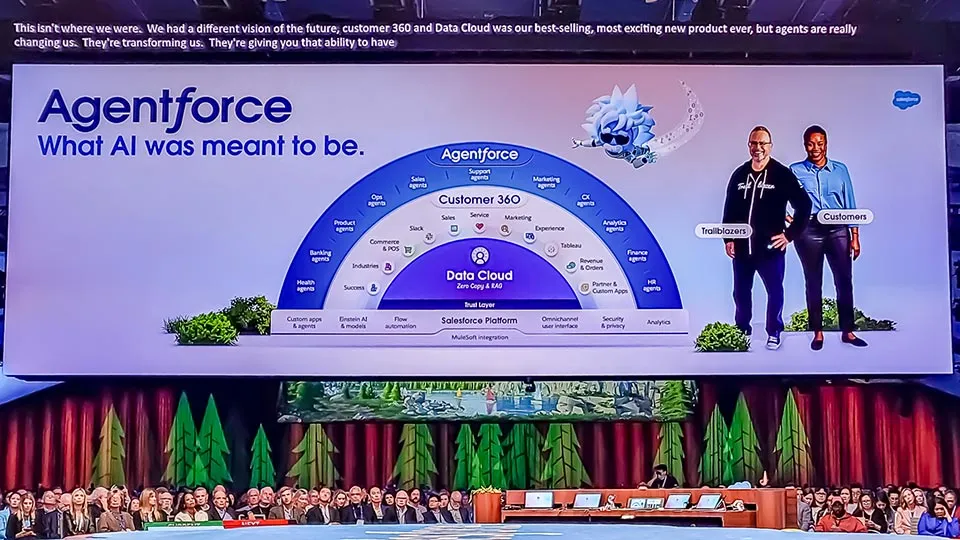
What Salesforce Actually Announced — and What It Means for You
A quick grounding, because the marketing is moving faster than most buyers can track. At TrailblazerDX 2026, Salesforce introduced Headless 360, which exposes every platform capability as an API, MCP tool, or CLI command. The pitch is that agents — not humans clicking through a UI — can now drive Salesforce. They paired it with Agentforce Vibes 2.0, a browser-based IDE for building agents using natural language, with multi-model support including Claude Sonnet and GPT-5. They added Agent Script, an open-source definition language for controlling agent behavior, and the Agentforce Experience Layer, which renders agent outputs as rich components inside Slack, Teams, Mobile, and other channels.
The strategic direction Salesforce co-founder Parker Harris articulated is striking: "Why should you ever log into Salesforce again?" That's not a feature announcement. That's a 2.5-year platform rebuild aimed at a future where AI agents do most of the work that humans currently do inside Salesforce orgs.
For some companies, that future is closer than they think. For others, it's a distraction from problems they haven't solved yet. The question is which one you are.
Question 1: Is Your Salesforce Data Actually Usable by an Agent?
This is the question that quietly kills most Agentforce implementations, and it's the one that almost never gets asked in the sales cycle.
Agentforce agents are grounded in your Salesforce data through Data 360 and Intelligent Context. When an agent answers a customer question, recommends a next step, or executes a workflow, it's reasoning over the records, knowledge articles, and unstructured documents in your org. If that data is incomplete, duplicated, stale, or inconsistently structured, the agent will produce confident-sounding answers that are quietly wrong.
I see this constantly. An org has 40,000 Account records, but only 8,000 have a populated Industry field. Contact records are split across three sales reps' personal habits — some use middle initials, some don't, some put titles in the Name field. Knowledge articles haven't been reviewed since 2022 and contradict each other on shipping policies. The Cases Object has six different "status" custom fields because three admins over five years each added their own.
An agent built on top of that org won't fail loudly. It will quietly hallucinate, escalate everything to humans, or — worst case — take incorrect actions on customer records.
Readiness Signal
Before adopting Agentforce, run a focused data audit on the objects your agents will actually touch. You don't need to clean the whole org. You need to clean the slice your use case depends on.
Question 2: Do You Have a Use Case That Justifies the Spend?
Agentforce isn't priced like a feature you toggle on. Between license costs, Data 360 consumption, and the implementation work to build, test, and govern agents responsibly, a real Agentforce deployment is a meaningful investment.
The use cases where I've seen clear ROI tend to share three traits: high volume, structured-enough inputs, and a measurable outcome the business is already trying to improve. Examples:
- Tier 1 support deflection where 60%+ of incoming cases are repetitive and well-documented
- Sales prospecting and enrichment where reps spend hours on research that an agent can do in seconds
- Internal knowledge retrieval where employees waste cycles searching across SharePoint, Confluence, and Salesforce for policies, procedures, or product details
- Order status and account servicing for transactional businesses with high inbound query volume
If your use case is "we want to use AI somewhere," that's not a use case. That's a budget line item looking for justification. The companies that get value out of Agentforce in year one are the ones that picked one painful, measurable problem and built a focused agent around it — not the ones that tried to AI-enable everything.
Question 3: Who's Going to Own This After Launch?
Agentforce agents are not static configurations. They're probabilistic systems that need ongoing monitoring, prompt refinement, evaluation, and governance. Salesforce themselves acknowledge this — Agent Health Monitoring, Agent Fabric, and the new evaluation tooling exist because agents drift, fail, and surprise you in ways traditional Salesforce automation doesn't.
Most mid-sized organizations don't have a clear answer to "who owns the agents." The Salesforce admin team has never run a probabilistic system. The data science team, if there is one, doesn't know Salesforce. IT thinks it's a CRM problem. The business owner thinks it's an IT problem.
If you can't name the person or team accountable for an agent's performance ninety days after launch — including responding to failures, refining its instructions, and reviewing its decisions — you're not ready to put one in production. You're ready to run a pilot.
Question 4: Is Your Org Architecture Ready for Headless?
Headless 360 is a fundamentally different operating model. Instead of users clicking through Lightning pages, agents call APIs, MCP tools, and CLI commands directly. That has real implications for orgs that have accumulated technical debt over years.
A few honest diagnostic questions:
- Validation rules and triggers: When an agent updates a record, will your existing automation behave correctly, or will it trigger cascading side effects nobody has tested in years?
- Permissions and sharing: Are your permission sets, profiles, and sharing rules clean enough that you'd trust an agent with the access you'd give a senior user?
- Integration architecture: If your agents need to reach into external systems — billing, ERP, custom databases — is that integration layer reliable, or is it held together with brittle middleware?
- Sandbox discipline: Can you test agent behavior end-to-end in a full sandbox that mirrors production, or do you ship config straight to prod?
Headless 360 amplifies whatever state your org is in. A clean, well-governed org becomes radically more powerful. A messy org becomes radically more dangerous.
Question 5: Are You Solving an Agentforce Problem or a Salesforce Problem?
This is the question I ask last, and it's often the most uncomfortable one.
A meaningful percentage of the "we need Agentforce" conversations I have are actually conversations about Salesforce problems that have nothing to do with AI. Adoption is low because the UI is overloaded. Reps don't trust the data because the data is bad. Service can't find anything because Knowledge was never properly structured. Leadership doesn't have visibility because reporting was never built out.
You can put an AI agent on top of any of those problems, and the agent will inherit them. Sometimes the right move isn't a new layer of intelligence on top of the platform — it's fixing what's underneath. Less exciting. Much cheaper. Often, much higher ROI.
A Framework You Can Actually Use
When clients come to us asking about Agentforce, this is the decision framework we walk through, in order:
- Identify one concrete, measurable use case. Not a vision. A problem with a number attached.
- Audit the data that use case depends on. Not the whole org. The slice you need.
- Name the owner. A specific person or team accountable post-launch.
- Pressure-test the underlying Salesforce foundation. Is the architecture ready?
- Compare the Agentforce solution to the non-AI alternative. Sometimes the answer is "fix the workflow first."
If you can clear those five hurdles, Agentforce is probably a strong investment. If you can't clear them yet, the answer isn't "no." It's "not yet — here's what to do first."
Where This Leaves You
The companies that will get the most out of Agentforce in 2026 and 2027 aren't the ones moving fastest. They're the ones moving deliberately — picking the right use case, cleaning the right data, building the right governance, and resisting the pressure to AI-enable everything because everyone else is talking about it.
Salesforce has built something genuinely powerful. Whether it's powerful for you depends on questions that have very little to do with the technology itself.
If you're working through this decision and want a second opinion that isn't trying to sell you an implementation, that's the kind of conversation Makini was built for. We do honest readiness assessments before we do roadmaps, and we'll tell you if the answer is "not yet."